
I’m going to be writing a little bit articles for you guys every now and then about random things and this is my first installment. Granted that I no longer play Magic nearly as much as I used to, I’m very sure that I still have a good enough grasp of the game and the formats that I can write these for you guys.
Standard is quite an interesting format right now. There isn’t a whole lot of variation going on, and the same decks continue to do well. Some would say that this makes for a stale format, but considering that it’s only a few weeks left until Born of the Gods comes out, I think it’s fine. Plus you can always brew up new decks that do work in this format, since it’s still kind of fresh.
The deck I’ll be taking a look in this article is my personal favorite deck choice and has been since Jace, the Mind Sculptor came out: UW Control. Now, William “Huey” Jensen just made the finals of GP: Dallas this last weekend with the deck, and the weekend prior, Stanislav Cifka made the Top 8 of GP: Vienna. They both played different builds, but overall, the decks are one in the same. Let’s take a look at the decklists.
UW Control by Andrew Cuneo, 2nd place by William “Huey” Jensen
4 Azorius Guildgate
4 Hallowed Fountain
8 Island
2 Mutavault
8 Plains
-26 Lands
4 Azorius Charm
4 Detention Sphere
4 Dissolve
4 Divination
1 Elixir of Immortality
2 Quicken
1 Ratchet Bomb
4 Sphinx’s Revelation
4 Supreme Verdict
2 Syncopate
1 Elspeth, Sun’s Champion
3 Jace, Architect of Thought
-34 Non-Creature Spells
Sideboard
1 Blind Obedience
3 Fiendslayer Paladin
3 Gainsay
1 Jace, Memory Adept
3 Last Breath
2 Negate
1 Pithing Needle
1 Ratchet Bomb
UW Control by Stanislav Cifka,
4 Azorius Guildgate
4 Hallowed Fountain
7 Island
2 Mutavault
6 Plains
2 Temple of Deceit
2 Temple of Silence
-27 Lands
4 Azorius Charm
4 Detention Sphere
4 Dissolve
2 Essence Scatter
4 Last Breath
4 Sphinx’s Revelation
4 Supreme Verdict
3 Elspeth, Sun’s Champion
4 Jace, Architect of Thought
-33 Non-Creature Spells
Sideboard
2 Archangel of Thune
3 Fiendslayer Paladin
4 Gainsay
2 Negate
1 Pithing Needle
3 Soldier of the Pantheon
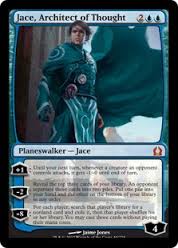
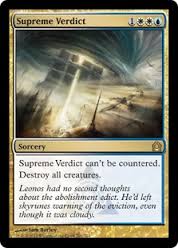
First off, there are some very obvious standout cards in both these lists that are pretty much unquestionable: Azorius Charm, Dissolve, Detention Sphere, Supreme Verdict, Sphinx’s Revelation, Jace, Architect of Thought and the Mutavaults. Usually these numbers do not change from list to list, but as we can see, Huey played only three Jace, which I myself found a little shocking. Many times, whenever I could cast a Jace, it was usually good: either stymieing the amount of damage I would take against the aggressive decks, as their focus would have to go towards Jace, or I would just draw some cards against the control decks until I had what I needed. I can see the reasoning behind playing three being that Jace can and does clog up your hand, but on turn four, I either want Supreme Verdict or Jace every time.
As for the individual differences between the two decklists, we see that Cifka had a full set of Last Breath’s in the main, while Huey had three of them in the sideboard. I’ve been playing with Last Breath since Day 1 to help deal with Voice of Resurgence, but that card has dropped in popularity and it still doesn’t stop Last Breath from being very good in this format. It’s a two mana removal spell that actually kills threats, unlike Azorius Charm. Nightveil Specter is one hell of a card if you didn’t know this already, and being able to cheaply remove it at the cost of nothing but two mana (as the life is completely irrelevant) is very beneficial. Against Mono-Black Devotion you can also use it to kill Pack Rats before they get out of control (but that’s less important in this deck, as you have Supreme Verdict and Detention Sphere to deal with it as well. Make sure you play around removal spells on their own Pack Rat if you are playing Detention Sphere to answer it however), you can also use it to kill Mutavault, which is something UW Control couldn’t really do before as it had a lack of hard removal spells. I personally think that I would end up playing Last Breath in the maindeck because of how aggressive the format tends to be here at Nugames on Monday nights.
After Dissolve, the countermagic in the format begins to start sucking. Syncopate is great when you’re ahead on mana, your opponent is mana screwed, or if they are only casting one giant spell a turn. In addition, being able to Exile things with it occasionally comes up vs things like Whip of Erebos. But if you’re behind on mana, your opponent is casting multiple spells a turn, or they are just flooded, then Syncopate becomes far worse. I like the fact that it can be a two-mana counter spell in the early game while you’re on the draw vs things like Underworld Connections, or on the play for some sort of aggressive creature, but besides that I find the card lackluster, but we have to play with what we got.
Essence Scatter has similar problems to Syncopate, being unable to counter real spells is annoying, but there are a good deal of must answer creatures out there that it helps against. I think that I prefer a split between Syncopate and Essence Scatter, but I also tend to play too many counterspells in my decks as people rarely know how to play around them correctly, or just don’t. Plus, knowing I’m safe towards the late game is always beneficial.
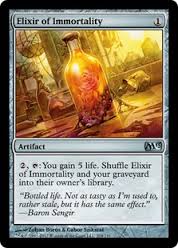
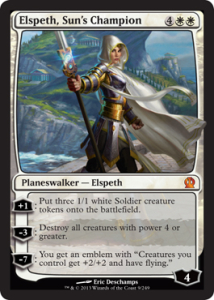
Now, this is where things start to get funky between the two decks. The goal of Huey’s build is to simply Elixir of Immortality over and over again, drawing your deck with Revelation and slowly grinding your opponent out of the game until you have an Elspeth that takes over, or your opponent decks themselves. Cifka’s build on the other hand would rather just play Elspeth and win the game that way. I love the Elixir win, but it’s just so much easier to win with Elspeth/Aetherling that I would much rather go that route. It requires you to dedicate more cards to actually winning the game, but I think with cards like Elspeth and how powerful they are when you cast them and even so much better when you untap with them, I find it hard to believe that I wouldn’t want to play them. Aetherling has been faded out as he really is just training wheels for a control player. He will win you games, yes, but those are games that you are more than likely already winning and being a dead card in your opening hand is pretty much the worst. Where the Elixir plan does shine the most is against Mono Black Devotion, where they can just very easily Hero’s Downfall or Thoughtseize away all of your Elspeth’s and Jace’s, which leaves you win condition list. This almost happened to me in a mirror match one time, but I’m very sure I made mistakes to get myself into a position where that happens, but it does happen.
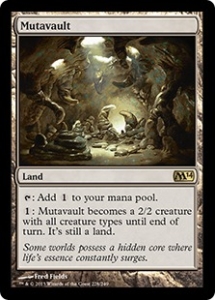
The Mutavaults in the deck are probably one of the sweetest cards in the deck. Being able to threaten opposing planeswalkers, such as Jaces, Ashioks or even random Chandras is pretty nice. Do not forget that when you activate Jace and your opponent is attacking with a 2/2, that you can block that with Mutavault and still have it live. You can also do some sweet tricks with Jace and Last Breath vs things like Boros Reckoner or any other three-power creature.
The more subtle differences in the deck are in the manabase, where Cifka choose to play four additional come in to play tapped Islands and Plains for the ability to Scry. I cannot wait until Born of the Gods comes out and we have (hopefully) a full set of Scry lands, as it sucks not having good fixing. We were pretty spoiled with Shocklands and the Core Set Buddy Lands though. I think some number of Scry lands in your UW deck is fine, but I’m not too keen on playing a full set of four until after Born of the Gods comes out. And yes, I would still play the Guildgate too. Mana is by far the most important thing in the game, and luckily when we have good manafixing, we can play more lands which allows us to also play some non-land lands in our decks such as the Mutavaults that you find here, or Kessig Wolf Run in older decks. Cifka choose to play 27 lands in his deck, while Huey played only 26. The reasoning behind this is that Huey has Divination and Quicken to help dig through his deck to help make land drops, and Azorius Charm also helps here too. He also didn’t play more than four come into play tapped lands, as he omitted the Scry Lands, which definitely need to be considered when you are deciding how many lands you wish to play. Personally, I’d play 27. You lose too many games to being manascrewed as opposed to being manaflooded, so why risk it? You have lategame mana sinks in Sphinx’s Revelation and you can also just trade off Mutavault if you are land clogged and feel like it is worth it too.
Huey’s choice of playing Divination and Quicken in his deck was something that I’ve done before and I’ve liked it a lot. Quicken into Supreme Verdict is just backbreaking at points, and being able to EOT Divination is pretty sweet. That being said, I also do not like Divination because of how bad it feels against the aggressive decks, which is a shame. The last time I played with UW Control, I played one Quicken and three Divinations, I boarded Divination out almost every match merely because I just wasn’t sure what I wanted to take out, and more likely because my sideboard was just too broad, but I’ll get to that later. With the Elixir plan, I definitely think that you have to be playing some number of Divinations and at the point, why wouldn’t you just play at least one Quicken? Try it out, because it’s pretty fun when you get to cast Supreme Verdict killing a Mutavault, dedevotioning a Thassa and wiping the rest of their durdly creatures when they attack.
The Ratchet Bomb in Huey’s deck is probably the worst card in my eyes. I’ve played Ratchet Bomb in UW Control decks since that card came out and it was always fantastic, however, I believe that when you are doing things like casting Detention Sphere or Jace, that you don’t really want to be ticking that Ratchet Bomb up more than two as it can get awkward to accidentally catch your own Detention Sphere and give your opponent a threat. It’s a great cheap board sweeper against tokens, but those aren’t too popular right now, but it is very effective at destroying multiple one-drop draws out of the aggressive red or white decks that exist.
The last thing I want to talk about in the main deck is Elspeth. This card is bananas. B-A-N-A-N-A-S. And she ain’t no hollaback girl. But seriously, I feel safe tapping out for Elspeth a large portion of the time and I’m the kind of person who hates to tap out. I live in fear of the worst happening, and I tend to play around nearly nothing, but Elspeth just doesn’t care. She brings all the boys to yard with her milkshake, turn after turn. I’ve even used her to kill two Blood Baron of Vizkopa’s that were attacking me. That was awesome. Her and Jace are BFF’s too, did you know that? The last time I had Elspeth and Jace in play at the same time, it was Jace, the Mind Sculptor and Elspeth, Knight-Errant. But these two work so much better together than the originals. Being able to make a small army to protect Jace to allow you to dig for answers is great, and the small army is also very good with Jace’s +1 just like with Mutavault. She’s a great card, a great win condition, and just kills incredibly fast. Usually, you have enough time to make her go to 8 and then ultimate, but sometimes you just don’t have to wait that long. I’m a more conservative player, so I believe it is correct to wait, unless you happen to always be dead on the following turn some how. In the future, if I could, I’d play 2-4 Elspeths in my deck.
As for the staple cards, here’s a few, quick tips.
-Cycle Azorius Charm in the beginning of the game if you aren’t casting it. It loses value in your hand every turn that you do not cast it, and leaving up mana only to waste it is playing bad with your mana. In addition, sometimes you don’t have to cast it when your opponent is attacking you. I will always cast it when my opponent has missed their land drop however, just to try and get them a little mana screwed, which should buy you time in the early game.
-Supreme Verdict should always be in mind with your mana, as you want to make sure to establish UUWW on turn four in order to cast Jace or Supreme Verdict. The double white is a bit of an issue for this, but as long as you just check yourself, you shouldn’t have issues. Don’t be afraid to kill just one creature, as some are worth it: Nightveil Specter, Pack Rat, Descration Demon, Blood Baron of Vizkopa, Stormbreath Dragon, and Mistcutter Hydra all come to mind as things that are worth killing by themselves. Try to hold them for value however if you can. People will overextend and get punished by you if you play it right. Jace on turn four is usually enough of a presence against the aggressive decks for you to want to hold Verdict for an additional turn.
-Dissolve is a hard counter and should really only be used on things that are going to win your opponent the game, or if you happen to need to dig for some kind of answer on that key turn, or if you don’t think that you will be casting it anytime soon. I tend to hold onto my Dissolves for harder to beat cards such as Underworld Connections, Planeswalkers or annoying to deal with creatures such as Stormbreath Dragon or Blood Baron of Vizkopa. Being able to answer hasters is probably more important that being able to counter a Blood Baron though. Also, having the protect against burn spells in the late game allows you to feel more safe provided that you continue to play around the burn spell as best as you can for the remainder of the game.
-Detention Sphere is your best removal spell as it can answer anything, but be conservative with it. If you need to stall in the early game, go ahead and cast it on turn three, but be aware that you only have four answers in your whole deck to troublesome permanents that aren’t creatures, such as Underworld Connections or Planeswalkers. Be aware that you might accidentally pick up your own permanents this way if you are playing against an opposing control deck, so if you have Jace in play, be wary of D-Sphering theirs. Post board, you can also get blow out hardcore by Disenchant effects, so if you can, try to be aware that those exist and have a plan just in case your opponent draws them to “get” you.
-Sphinx’s Revelation is obviously the most powerful card in the deck and the best card in the deck and the reason why most people want to play this deck. When you can cast a Revelation for a good amount of cards and life, usually around four or five, it becomes pretty hard to lose. Being able to chain one into another via drawing it is pretty sickening as well. Don’t be afraid to Rev for smaller amounts such as two or three in the earlier games if you find yourself having too many expensive spells in your hand. Additionally, Revelation is only good when you have mana, so make sure that you are able to hit all of your land drops each turn and your future Revelations will be better. Missing land drops is very bad for you and makes it more difficult for you to come back.
The sideboard is the final piece of the puzzle, and is usually a puzzle that people do not understand, but I’ll write another broad article about sideboarding sometime in the future. Both Cifka and Huey play similar cards in their sideboards, with three Fiendslayer Paladin appearing in each, along with three Gainsay (Cifka had a fourth though), two Negates and a miser’s copy of Pithing Needle. Cifka’s sideboard is more of an extremely focused sideboard, where he has four copies of Gainsay for Mono-Blue Devotion, the eight creatures against aggressive decks or against the control decks as an aggro plan, the two Negates are a nice catchall that is good in the mirror and the Needle is a card that I like to play in the sideboard of every single one of my non-aggro decks. Huey has some sweet ones however, with a Blind Obedience (which I find to be the best card possible against cards like Mistcutter Hydra and other various haste creatures), a Jace, Memory Adept for those grindy matchups where they don’t have Hero’s Downfall (like the mirror, but it’s probably coming in against Mono Black Devotion anyway) and another copy of Ratchet Bomb, which is best against Token decks as I said before, and the hyper-aggro decks with many one drops. I don’t prefer one sideboard to the other, as sideboards are very meta-dependent, but it’s always good to know which matchups you have cards in your sideboard for and which matchups you are skimming on. In fact, I really like playing Glare of Heresy in the sideboard, yet neither list had any in the 75′s. Building the sideboard really depends on what your playstyle with the deck is and where you have weaknesses as a player too.
Thanks for the read and hopefully now you know a lot more about UW Control in Standard. For future articles, I’d love for request for things that you all would like to learn about or hear about or get my perspective on. Just let me know anytime and I’ll likely write something about it.
The views and opinions expressed in this article are the author’s and do not necessarily reflect the official position of Nugames.
